Enterprise AI in 2026: Which Platforms Actually Meet the Bar? A CIO/CAIO Briefing
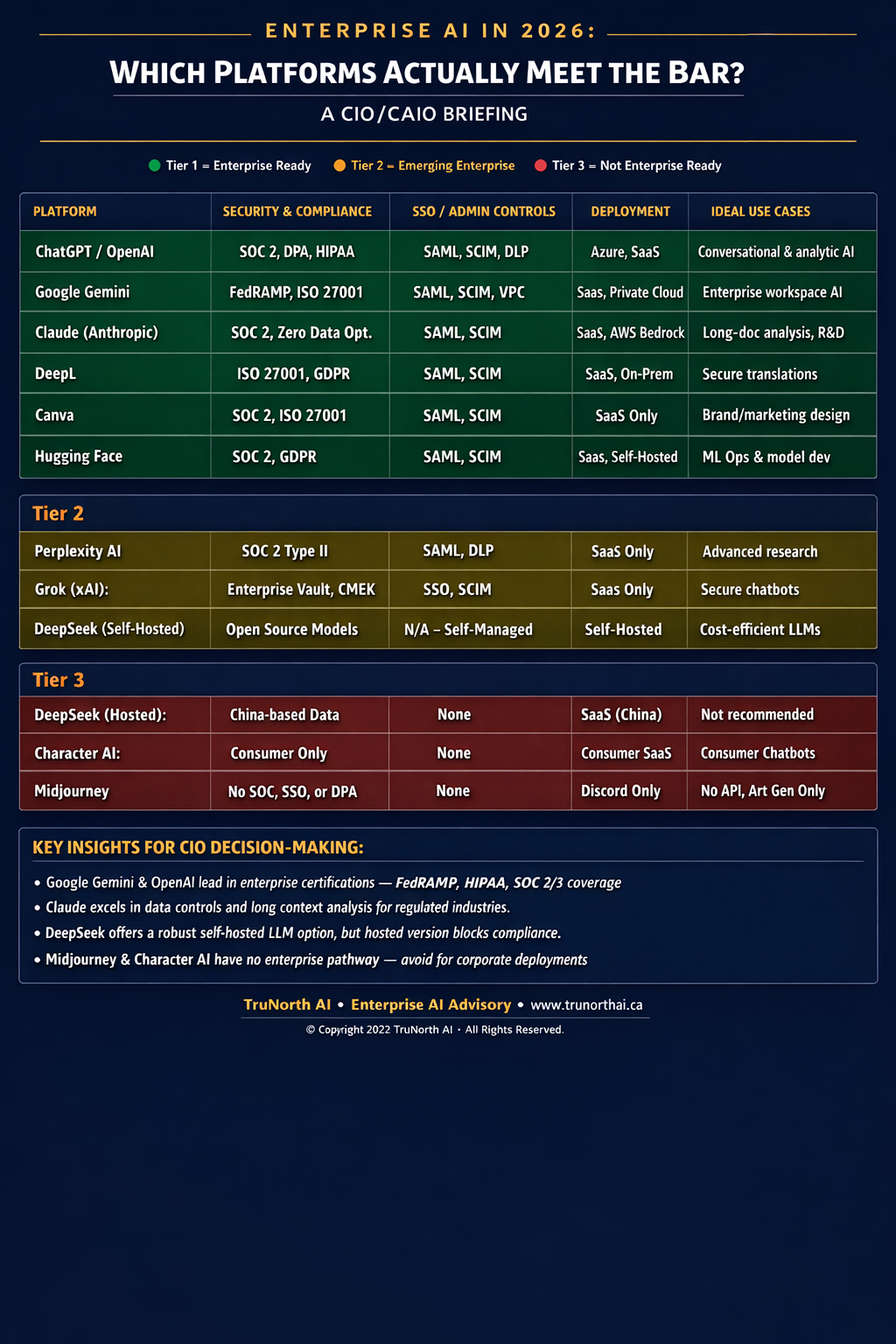
We evaluated 11 leading AI platforms against what actually matters to CIOs and CAIOs: compliance certifications, SSO/SAML, admin controls, audit logging, data governance, and deployment flexibility. The result is a tier-ranked comparison matrix that separates enterprise-ready platforms from consumer tools wearing a business suit. Making procurement decisions or briefing your board? This is your cheat sheet.
The AI market is noisy. Every vendor claims “enterprise‑grade” capabilities, yet only a fraction of platforms meet the operational, security, and governance thresholds required for real deployment inside a modern enterprise. For CIOs and Chief AI Officers, the question isn’t “Which AI tool is impressive?” It’s “Which AI platform can I safely operationalize across the organization?” Below is a clear, executive‑level assessment of which platforms truly offer enterprise functionality in 2026 — and which remain consumer‑grade.

Platforms That Meet Enterprise Requirements
ChatGPT / OpenAI
OpenAI’s enterprise offerings provide the controls CIOs expect: SOC 2 compliance, SSO/SAML, zero‑retention data handling, admin governance, and SLAs. The Enterprise API supports scalable integration into core systems and workflows. For organizations building AI into the operating model, this is a mature option.
Google Gemini
Gemini for Workspace Enterprise and the Gemini API deliver deep integration across Google’s productivity ecosystem. With long‑context reasoning and strong compliance posture, Gemini is well‑suited for enterprises standardizing on Google Workspace or requiring high‑volume document analysis.
Claude (Anthropic)
Claude’s enterprise tier is optimized for precision, long‑context reasoning, and high‑stakes use cases. Legal, financial, and research teams benefit from its ability to process and interpret large volumes of structured and unstructured data with governance controls in place.
Perplexity AI
Perplexity Enterprise Search is built for analysts and decision‑makers who require real‑time, citation‑backed intelligence. It’s not a general assistant — it’s an enterprise research engine with privacy‑first design and team‑level controls.
DeepSeek
DeepSeek offers enterprise APIs and self‑hostable models, making it attractive for organizations prioritizing cost efficiency, deployment flexibility, and control over data. It’s gaining traction among engineering‑led enterprises building internal AI capabilities.
Grok (xAI)
Grok’s enterprise API is emerging as a contender for organizations that prioritize reasoning performance and want access to a model optimized for analytical workloads. While still maturing, it’s already being evaluated alongside the major players.
DeepL
DeepL Enterprise provides secure, compliant translation workflows for global organizations. For enterprises with multilingual operations, DeepL remains a trusted component of the localization stack.
Canva
Canva Enterprise offers brand governance, SSO, and administrative controls. For marketing and communications teams, it provides a scalable, governed environment for AI‑assisted content creation.
Hugging Face
Hugging Face Enterprise Hub and Private Endpoints support VPC and on‑prem deployments. For enterprises building custom AI infrastructure or requiring strict data residency, Hugging Face is a strategic platform.
Platforms That Do Not Meet Enterprise Requirements
Character.AI
A consumer‑oriented platform with no enterprise governance, compliance, or administrative controls. Not suitable for organizational deployment.
Midjourney
A powerful creative tool, but its Discord‑based workflow lacks the compliance, auditability, and governance required for enterprise use.
What This Means for CIOs and CAIOs
The enterprise AI landscape is bifurcating:
- Platforms that can be operationalized — with governance, compliance, and integration pathways.
- Platforms that remain consumer‑grade — impressive, but not deployable at scale.
For CIOs and CAIOs, the mandate is clear: Select platforms that align with your security posture, data strategy, and AI operating model — not just those that generate impressive demos. The organizations that win in 2026 will be the ones that treat AI as infrastructure, not novelty.